From Pasture to Jar: How We Render Tallow the Old-Fashioned Way
From Pasture to Jar: How We Render Tallow the Old-Fashioned Way Subtitle / Tagline: A behind-the-scenes look at our small-batch process and why we'll never mass-produce.
Introduction:
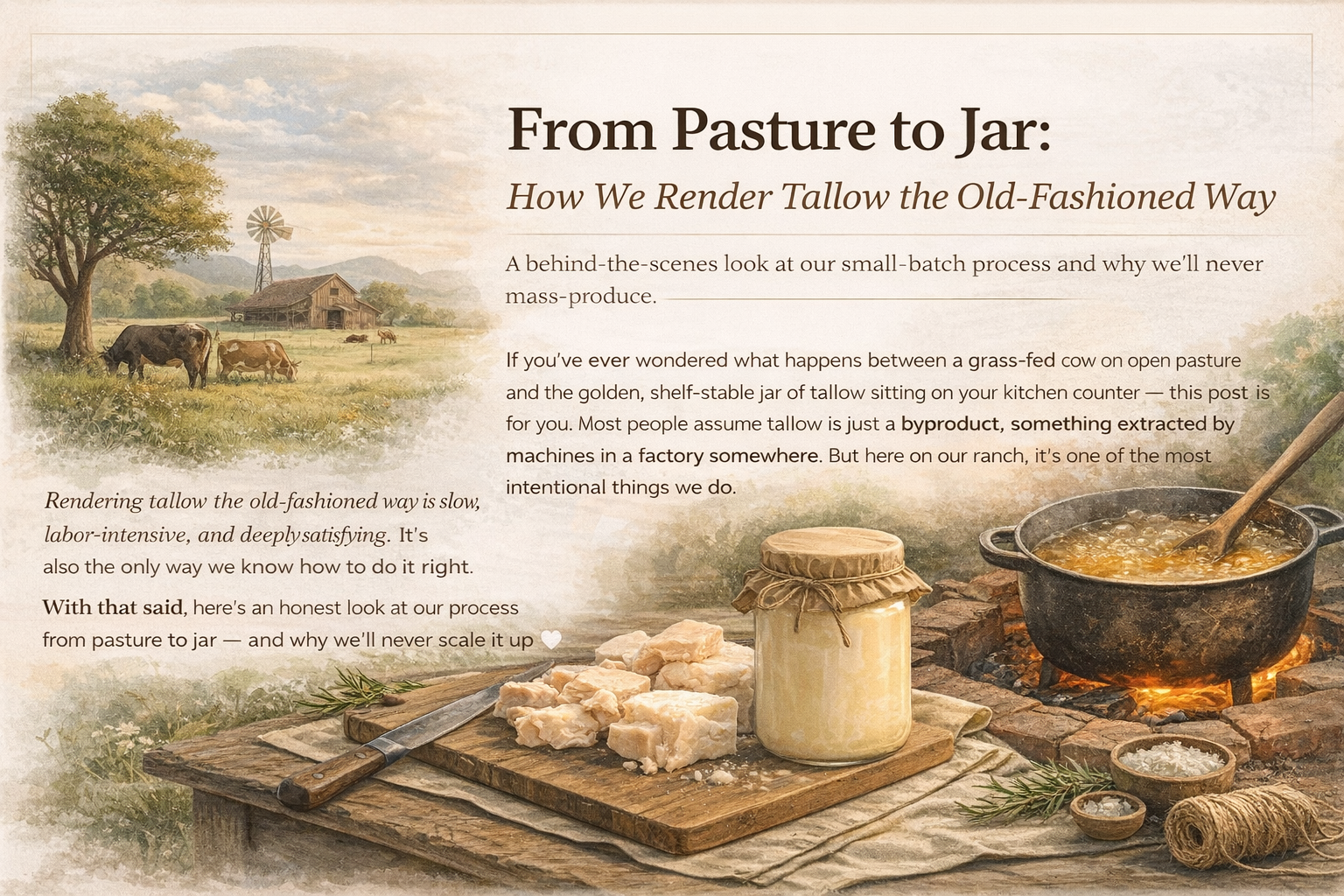
If you've ever wondered what happens between a grass-fed cow on open pasture and the golden, shelf-stable jar of tallow sitting on your kitchen counter — this post is for you. Most people assume tallow is just a byproduct, something extracted by machines in a factory somewhere. But here on our ranch, it's one of the most intentional things we do.
Rendering tallow the old-fashioned way is slow, labor-intensive, and deeply satisfying. It's also the only way we know how to do it right.
1. It starts with the animal, not the product
Everything about how we render tallow begins long before the rendering pot comes out. It starts with how our cattle are raised — on open pasture, grass-fed and grass-finished, with no hormones or antibiotics. The quality of fat you get at the end is a direct reflection of how the animal lived. Stressed cattle on poor feed produce poor fat. It's that simple.
2. We source only the leaf fat
Not all beef fat is created equal. We use kidney fat, also called leaf fat — the dense, firm fat that surrounds the kidneys and loins. It's the purest fat on the animal, nearly odorless, and produces the whitest, most shelf-stable tallow. Most commercial producers skip this step and use mixed trimmings. We don't.
3. The fat is hand-trimmed and cleaned
Before anything hits the pot, the fat is hand-trimmed. We remove any remaining meat, tissue, or blood spots. This is tedious, time-consuming work — and it's exactly why small-batch tallow looks and smells different from anything mass-produced. Clean fat in, clean tallow out.
4. We render low and slow
Our rendering process uses a low, steady heat — no rushing, no shortcuts. The fat is cut into small pieces (or ground, depending on the batch) and placed into a heavy pot over a controlled flame. It can take several hours for the fat to fully render out. During this time, someone is always present, stirring, skimming, and watching the temperature.
High heat destroys the beneficial properties of tallow and can give it an unpleasant smell. Low-and-slow preserves everything that makes grass-fed tallow worth using.
5. We skim and strain — multiple times
As the fat renders, impurities rise to the top. We skim them off throughout the process. Once the liquid fat is ready, it's strained through fine mesh — and then strained again. The result is a clear, golden liquid that sets into a creamy white solid as it cools.
No fillers. No preservatives. No shortcuts.
6. Every jar is filled and sealed by hand
Once the tallow has been strained and cooled slightly, it's poured into glass jars by hand. Each jar is filled, wiped clean, labeled, and sealed — one at a time. We check every jar. There's no assembly line here. That's intentional.
7. Why we'll never mass-produce
We get asked this a lot. The honest answer is: because we can't do it this way at scale, and this way is the only way we want to do it.
Mass production means cutting corners — using mixed fat sources, faster rendering times, mechanical filtering, and longer supply chains. Every one of those shortcuts takes something away from the final product.
Our tallow is made in small batches, from animals we raise, on land we manage. That relationship between rancher and product is what makes it different. The moment we outsource that, it's just another jar on a shelf.
8. You can taste the difference — and feel it
Grass-fed, small-batch tallow has a clean, subtle flavor that store-bought lard and refined oils can't match. It has a high smoke point, stays stable at room temperature, and is rich in fat-soluble vitamins like A, D, E, and K. Generations of people cooked with this. We're just bringing it back.
Start your own tallow journey — a quick checklist:
Here's a quick guide to getting started with grass-fed tallow at home or in your kitchen. Remember: imperfect action beats inaction.
Source quality leaf fat from a local grass-fed ranch or butcher
Trim the fat by hand — remove all meat and tissue
Cut or grind the fat into small, even pieces
Render on low heat (around 200–250°F) for 2–4 hours, stirring occasionally
Skim impurities off the top as they rise during rendering
Strain the liquid tallow through fine mesh — twice if needed
Pour into clean glass jars while still warm and liquid
Let cool at room temperature, then seal and label
Store at room temperature for up to a year, or refrigerate for longer shelf life
Use in place of butter, lard, or vegetable oils for cooking, baking, or skin care
